Prabir Purkayastha v. State (NCT of Delhi)
- Court
- Supreme Court of India
- Decision date
- 15 May 2024
- Citation / docket
- 2024 INSC 414
- Source length
- 42 PDF pages
- Review status
- AI-assisted draft; not reviewed by a lawyer
- Court text: extracted from the linked source PDF; possible reading and encoding errors.
- Summary: separate AI-assisted draft.
- Coverage: Added to this collection on 29 October 2026; checked against the existing live collection before publication.
Draft summary
Written with AI assistance from the source judgment. Not reviewed by a lawyer. Historical decision summary, independently checked by an AI reviewer; not a current-law certification.
In one sentence
Failure to supply written grounds of arrest before remand invalidated the arrest and remand in this UAPA case.
Question decided
Were the arrest and remand lawful when the accused had not received the grounds of arrest in writing before the remand order?
Key holdings
- Personal grounds of arrest must be distinguished from generic reasons for making an arrest.Source PDF pages: 39, 40.
- The purported communication through the remand application did not reach the accused or his counsel before the remand order, vitiating the arrest and remand.Source PDF pages: 40.
- The Court expressly declined to determine the merits of the criminal allegations.Source PDF pages: 37, 41.
Outcome
The arrest, remand order and challenged High Court order were set aside. Because the charge sheet had been filed, release was directed on bail and bonds to the trial court's satisfaction.
Source PDF pages: 40, 41.Plain-English explanation
Prabir Purkayastha challenged the legality of his arrest and remand in a prosecution under the Unlawful Activities (Prevention) Act. The Supreme Court focused on whether he had received the grounds of arrest in writing in time to contest the request for custody. It distinguished the general reasons that may justify arrest, such as preventing interference with evidence, from the specific factual grounds connecting a particular person to the alleged offence. A routine arrest form was not enough. On the facts, the purported communication through the remand application had not been supplied to the accused or his lawyer before the remand order was passed. The Court therefore set aside the arrest and remand, together with the challenged High Court order. Since the charge sheet had already been filed, it directed release on bail and bonds to the trial court's satisfaction. The decision was not an acquittal and did not decide whether the underlying allegations were true. The source includes an image of a remand order; that image is preserved in this preview because text extraction alone did not capture it.
Relevant law in the judgment
- Constitution: Articles 22(1) and 141
- Unlawful Activities (Prevention) Act: section 43B
- CrPC: arrest and remand provisions
Separate opinions
The judgment is signed by B.R. Gavai and Sandeep Mehta JJ.
Research notes and limits
Check later decisions defining the timing and scope of communication of arrest grounds. A March 2025 Supreme Court order citing this case is identified in the review notes. Do not describe release as exoneration.
Source and extraction notes
Unchanged source PDF · Source website
- PDF page 4 is a scanned annexure not captured by text extraction; its page image is shown. Page 42 is an almost-empty source page and is also retained as an image.
Judgment — source material
The section below reproduces machine-extracted court text, with original page images where extraction is unreliable. It is not an AI rewrite. Each page links to the unchanged PDF.
Jump to a source page
1 · 2 · 3 · 4 · 5 · 6 · 7 · 8 · 9 · 10 · 11 · 12 · 13 · 14 · 15 · 16 · 17 · 18 · 19 · 20 · 21 · 22 · 23 · 24 · 25 · 26 · 27 · 28 · 29 · 30 · 31 · 32 · 33 · 34 · 35 · 36 · 37 · 38 · 39 · 40 · 41 · 42
Source PDF page 1
View this page in the original PDF2024 INSC 414
1
REPORTABLE
IN THE SUPREME COURT OF INDIA
CRIMINAL APPELLATE JURISDICTION
CRIMINAL APPEAL NO(S). OF 2024
(Arising out of SLP(Crl.) NO(S). OF 2024)
(D.No. 42896/2023)
PRABIR PURKAYASTHA ….APPELLANT(S)
VERSUS
STATE(NCT OF DELHI) …RESPONDENT(S)
J U D G M E N T
Mehta, J.
1. Leave granted.
2. The instant appeal by special leave is preferred on behalf of
the appellant for assailing the order dated 13 th October, 2023
passed by learned Single Judge of the High Court of Delhi whereby
the learned Single Judge dismissed the Criminal Miscellaneous
Case No. 7278 of 2023 filed by the appellant seeking the following
directions: -
Source PDF page 2
View this page in the original PDF2 "A. Declare the arrest of the Petitioner as illegal and in gross violation of the fundamental rights of the Petitioner guaranteed under Article 21 and 22 of the Constitution of India in relation to FIR No. 224/2023 dated 17.08.2023 PS Special Cell, Lodhi Road, Delhi Police; B. Declare and set aside the Remand Order dated 04.10.2023 passed by the Ld. Special Judge, Patiala House Court as null and void as the same being passed in complete violation of all constitutional mandates including failure to consult and to be defended by legal practitioner of his choice during the Remand Proceedings, being violative of Petitioner's right guaranteed under Article 22 of the Constitution of India. C. Direct immediate release of the Petitioner from custody in FIR No. 224/2023 dated 17.08.2023 PS Special Cell, Lodhi Road, Delhi Police." Brief Facts: - 3. The officers of the PS Special Cell, Lodhi Colony, New Delhi carried out extensive raids at the residential and official premises of the appellant and the company, namely, M/s. PPK Newscli ck Studio Pvt. Ltd. (“said company”) of which the appellant is the Director in connection with FIR No. 224 of 2023 dated 17th August, 2023 registered at PS Special Cell, Lodhi Colony, New Delhi for the offences punishable under Sections 13 , 16, 17, 18, 22C of the Unlawful Activities(Prevention) Act, 1967(for short “UAPA”) read with Section 153A , 120B of the Indian Penal Code, 1860(hereinafter being referred to as the ‘IPC’). During the course of the search and seizure proceedings, numerous documents and digital devices belonging to the appellant, the company and other
Source PDF page 3
View this page in the original PDF3 employees of the company were seized. The appellant was arrested in connection with the said FIR on 3 rd October, 2023 vide arrest memo(Annexure P-7) prepared at PS Special Cell, Lodhi Colony, New Delhi. 4. It is relevant to mention here that the said arrest memo is in a computerised format and does not contain any column regarding the ‘grounds of arrest’ of the appellant. This very issue is primarily the bone of contention between the parties to the appeal. 5. The appellant was presented in the Court of Learned Additional Sessions Judge -02, Patiala House Courts, New Delhi(hereinafter being referred to as the ‘ Remand Judge’) on 4th October, 2023, sometime before 6:00 a.m. which fact is manifested from the remand order(Annexure P-1) placed on record of appeal with I.A. No. 217857 of 2023. The appellant was remanded to seven days police custody vide order dated 4th October, 2023. 6. The proceedings of remand have been seriously criticized as being manipulated by Shri Kapil Sibal, learned senior counsel for the appellant and aspersions of subsequent insertions in the remand order have been made . Hence, it would be apposite to reproduce the remand order dated 4th October, 2023 in pictorial form so as to form a part of this judgment.
Source PDF page 4
View this page in the original PDF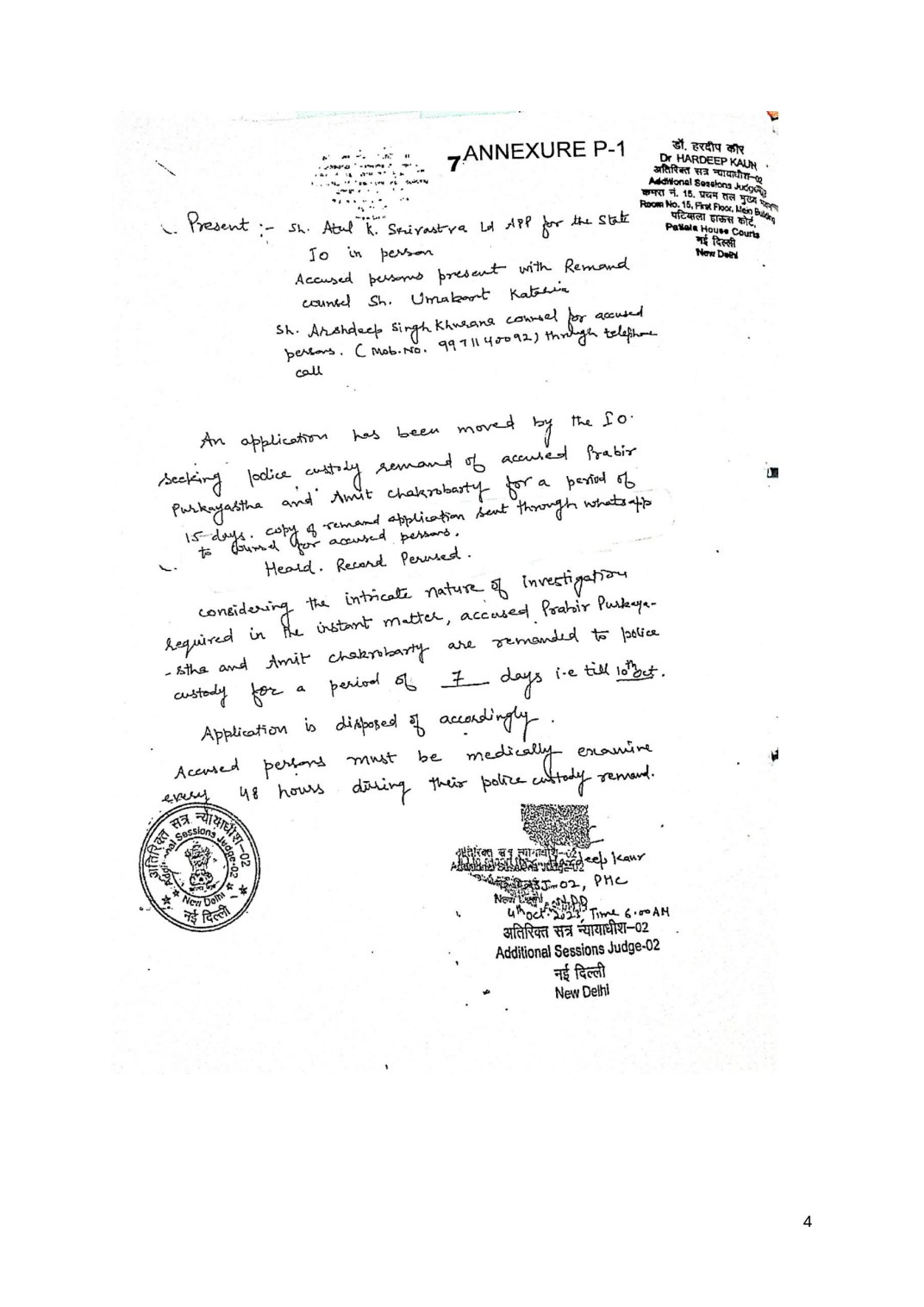
Source PDF page 5
View this page in the original PDF5 7. The appellant promptly questioned his arrest and the police custody remand granted by the learned Remand Judge vide order dated 4th October, 2023 by preferring Criminal Miscellaneous Case No. 7278 of 2023 in the High Court of Delhi which stands rejected by the learned Single Judge of the High Court of Delhi vide judgment dated 13th October, 2023. The said order is subjected to challenge in this appeal by special leave. Submissions on behalf of the appellant: - 8. Shri Kapil Sibal, learned senior counsel representing the appellant canvassed the following submissions in order to question the proceedings of arrest and remand of the appellant: - (i) That the FIR No. 224 of 2023(FIR in connection of which appellant was arrested) is virtually nothing but a second FIR on same facts because prior thereto, another F IR No. 116 of 2020 dated 26th August, 2020 had been registered by PS EOW, Delhi Police (“EOW FIR”) alleging violation of Foreign Direct Investment(FDI) regulations and other laws of the country by the appellant and the company, thereby
Source PDF page 6
View this page in the original PDF6 causing loss to the exchequer. A copy of the said FIR was, however, not provided to the appellant. By treating the EOW FIR as disclosing predicate offences, the Directorate of Enforcement(for short “ED”) registered an Enforcement Case Information Report(for short ‘ECIR’) for the offences punishable under Sections 3 and 4 of the Prevention of Money Laundering Act, 2002 (for short ‘PMLA’) . The ED carried out extensive search and seizure operations at various places including the office of the company-M/s. PPK Newsclick Studio Pvt. Ltd. , of which the appellant is the Director. (ii) The company assailed the ECIR by filing Writ Petition(Crl.) Nos. 1129 of 2021 and 1130 of 2021 wherein interim protection against coercive steps was granted by High Court of Delhi on 21st June, 2021. The appellant was also provided interim protection in an application seeking anticipatory bail vide order dated 7th July, 2021. (iii) The FIR No. 224 of 2023 has been registered purely on conjectures and surmises without there being any substance in the allegations set out in the report. The contents of the FIR which were provided to the appellant
Source PDF page 7
View this page in the original PDF7 at a much later stage discloses a purely fictional story without any fundamental facts or material warranting registration of the FIR. (iv) Admittedly, the copy of FIR No. 224 of 2023 was neither made available in the public domain nor a copy thereof supplied to the appellant until his arrest and remand which is in complete violation of the fundamental Right to Life and Personal Liberty enshrined in Articles 20, 21 and 22 of the Constitution of India. (v) Shri Sibal pointed out that the learned Remand Judge , vide order dated 5th October, 2023, allowed the application filed by the appellant seeking certified copy of the said FIR which was provided to the learned counsel for the appellant in the late evening on 5th October, 2023, i.e., well after the appellant had been remanded to police custody. (vi) That the grounds of arrest were not informed to the appellant either orally or in writing and that such action is in gross violation of the constitutional mandate under Article 22(1) of the Constitution of India and Section 50 of the Code of Criminal Procedure, 1973 (hereinafter being referred to as the ‘CrPC’).
Source PDF page 8
View this page in the original PDF8 (vii) Reliance was placed by the learned senior counsel on the judgment of this Court in Pankaj Bansal v. Union of India and Others 1 and it was contended that the mere passing of successive remand orders would not be sufficient to validate the initial arrest, if such arrest was not in conformity with law. Learned senior counsel urged that this Court in the c ase of Pankaj Bansal (supra) interpreted the provision of Section 19(1) of PMLA which is pari materia to the provisions contained in Section 43B(1) of the UAPA. Thus, the said judgment fully applies to the case of the appellant. (viii) Shri Sibal referred to the observations made in the judgment of Pankaj Bansal(supra) and urged that since the grounds of arrest were not furnished to the appellant at the time of his arrest and before remanding him to police custody, the continued custody of the appellant is rendered grossly illegal and a nullity in the eyes of law because the same is hit by the mandate of Article 22(1) of the Constitution of India. 1 2023 SCC OnLine SC 1244
Source PDF page 9
View this page in the original PDF9 (ix) Shri Sibal further urged that the view taken by a two- Judge Bench of this Court in Ram Kishor Arora v. Directorate of Enforcement2 holding the judgment in Pankaj Bansal (supra) to be prospective in operation would also not come in the way of the appellant in seeking the relief. He pointed out that the judgment in the case of Pankaj Bansal (supra) was pronounced on 3 rd October, 2023 whereas the illegal remand order of the appellant was passed on 4th October, 2023 and hence, the law laid down in the case of Pankaj Bansal(supra) is fully applicable to the case of the appellant despite the interpretation given in Ram Kishor Arora(supra). (x) That the arrest of the appellant is in gross violation of the provisions contained in Article 22 of the Constitution of India, hence, the appellant is entitled to seek a direction for quashment of the remand order and release from custody forthwith. (xi) That the action of the Investigating Officer in arresting and in seeking remand of the appellant is not only mala fide but also fraught with fraud of the highest order. 2 2023 SCC OnLine SC 1682
Source PDF page 10
View this page in the original PDF10 (xii) Referring to the remand order dated 4 th October, 2023, it was contended that the appellant was kept confined overnight by the Investigating Officer without conveying the grounds of arrest to him. He was presented in the Court of the learned Remand Judge on 4th October, 2023 in the early morning without informing Shri Arshdeep Khurana, the Advocate engaged on behalf of the appellant who was admittedly in contact with the Investigating Officer because he had attended the proceedings at the Police Station Lodhi Colony, post the appellant’s arrest. In order to clandestinely procure police custody remand of the appellant , the Investigating Officer, presented the appellant at the residence of learned Remand Judge before 6:00 a.m. by informing a remand Advocate Shri Umakant Kataria who had never been engaged by the appellant to plead his cause. (xiii) Learned Remand Judge remanded the accused to police custody at 6:00 a.m. sharp as is evident from the remand order(supra). Shri Arshdeep Khurana, t he appellant’s Advocate was informed about the order granting remand by a WhatsApp message at 7:07 a.m. but the same was an
Source PDF page 11
View this page in the original PDF11 exercise in futility because there was no possibility that the learned Advocate could have reached the residence of the learned Remand Judge in time to oppose the prayer for remand. (xiv) That, a s a matter of fact, the remand application had already been accepted at 6 :00 a.m. which fact is manifested from the time appended at the end of the remand order(supra). The learned Remand Judge signed the proceedings by recording the time as 6:00 a.m. Hence, there is no escape from the conclusion that the remand order was passed without supplying copy of the grounds of arrest to the appellant or the Advocate engaged by him. The appellant was intentionally deprived from information about the grounds of his arrest and thereby he and his Advocate were prevented from opposing the prayer of police custody remand and from seeking bail. (xv) He further urged that the stand taken by the respondent that the grounds of arrest were conveyed to the learned counsel for the appellant well before the learned Remand Judge passed the remand order is unacceptable on the face of the record because the time of passing the remand
Source PDF page 12
View this page in the original PDF12 order is clearly recorded in the order dated 4 th October, 2023 as 6:00 a.m. Admittedly, the grounds of arrest were conveyed to Shri Arshdeep Khurana, Advocate for the appellant well after 7:00 a.m. It was contended that the noting made by the learned Remand Judge in the order dated 4 th October, 2023 that the learned counsel for the appellant was heard on the application for remand is a subsequent insertion clearly visible from the remand order. The fact of subsequent insertion of these lines is fortified from the fact that the appellant had already been remanded to police custody by the time the Advocate was informed and the copy of the remand application containing the purported grounds of arrest was transmitted to him. (xvi) That the foundational facts in the FIR No. 224 of 2023 are almost identical to the allegations set out in the EOW FIR. The appellant had been granted protection against arrest by the High Court of Delhi in the EOW FIR. Owing to this protection, the mala fide objective of the authorities in putting the appellant behind bars was not being served and, therefore, a new FIR No. 224 of 2023 with totally
Source PDF page 13
View this page in the original PDF13 cooked up allegations came to be registered and the appellant was illegally deprived of his liberty without the copy of the FIR been provided and without the grounds of arrest being conveyed to the appellant. 9. On these grounds, Shri Sibal implored the Court to accept the appeal, set aside the impugned orders and direct the release of the appellant from custody in connection with the above FIR. Submission on behalf of the respondent: - 10. Per contra , Shri Suryaprakash V. Raju, learned ASG, appearing for the respondent vehemently and fervently opposed the submissions advanced by the learned counsel for the appellant and made the following pertinent submissions:- (i) He urged that the judgment in the case of Pankaj Bansal(supra) has been held to be prospective in operation by this Court in the case of Ram Kishor Arora(supra). (ii) The appellant was remanded to police custody on 4th October, 2023 whereas the judgment in the case of Pankaj Bansal(supra) was uploaded on the website of this Court in the late hours of 4 th October, 2023 and hence, the arresting officer could not be expected to ensure compliance of the
Source PDF page 14
View this page in the original PDF14 directions given in the said judgment. He thus urged that the alleged inaction of the Investigating Officer in furnishing the grounds of arrest in writing to the appellant cannot be called into question as the judgment in Pankaj Bansal(supra) was uploaded and brought in public domain after the remand order had been passed. (iii) Without prejudice to the above, learned ASG urged that as per the appellant’s version set out in the pleadings filed before the High Court of Delh i, he was actually remanded to the police custody after 7:00 a.m. With reference to these pleadings, Shri Raju contended that the appellant cannot be heard to urge that he was remanded to the police custody in an illegal manner and without the grounds of arrest having been conveyed to him in writing. (iv) Learned ASG referred to the provisions contained in Article s 22(1) and 22(5) of the Constitution of India and urged that there is no such mandate in either of the provisions that the grounds of arrest or detention should be conveyed in writing to the accused or the detenue, as the case may be. (v) He urged that the right conferred upon the appellant by Article 22(1) of the Constitution of India to consult and to be defended
Source PDF page 15
View this page in the original PDF15 by a legal practitioner was complied with in letter and spirit because the relative of the appellant, namely, Shri Rishabh Bailey, was informed before producing the appellant before the learned Remand Judge. Admittedly, Shri Rishabh Bailey had intimated the appellant’s Advocate, Shri Arshdeep Khurana regarding the proposed proceedings of police custody remand of the appellant. (vi) He urged that the Advocate transmitted a written objection against the prayer for police custody remand over WhatsApp through the Head Constable Rajendra Singh and the learned Remand Judge has taken note of the said objection opposing remand in the remand order dated 4th October, 2023 and thus it would be futile to argue that the order granting remand is illegal in any manner. (vii)Learned ASG further contended that now the investigation has been completed and charge sheet has also already been filed and, thus, the illegality/irregularity, if any, in the arrest of the appellant and the grant of initial police custody remand stands cured and hence, the appellant cannot claim to be prejudiced by the same.
Source PDF page 16
View this page in the original PDF16 (viii)He vehemently urged that there are significant differences in the language employed in Section 19 of the PMLA and Section 43A and 43B of the UAPA and, thus, the law as laid down by this Court in Pankaj Bansal(supra) does not come to the aid of the appellant in laying challenge to the remand order. (ix) Learned ASG further urged that there is a presumption regarding the correctness of act s performed in discharge of judicial functions and hence, the noting recorded in the remand order dated 4 th October, 2023 that the Advocate for the appellant had been heard on the remand application and that the grounds of arrest had been conveyed to the appellant cannot be questioned or doubted. He thus implored the Court to dismiss the appeal and affirm the order passed by the High Court of Delhi. Rejoinder on behalf of learned counsel for the appellant: - 11. Shri Sibal, learned senior counsel for the appellant submitted that the argument advanced by learned ASG that the provisions contained in Section 19 of the PMLA and Section 43A and 43B of the UAPA operate in different spheres, is misconceived. He urged
Source PDF page 17
View this page in the original PDF17 that language of both the provisions is pari materia and hence, the law laid down in Pankaj Bansal (supra) fully covers the controversy at hand. 12. Shri Sibal emphasised that on a plain viewing of the order dated 4 th October, 2023, it is clear that the lines indicating the sending of the copy of the remand application to the learned counsel for the appellant and the opportunity of hearing provided to the Advocate through telephone call have been subsequently inserted in the order. He thus urged that the plea advanced by Shri Raju, learned ASG that there is a presumption regarding the correctness of judicial proceedings cannot be accepted as a gospel truth in the peculiar facts of the case at hand. He contended that applying the same principle to the remand order dated 4th October, 2023 is counter productive to the stand taken by learned ASG inasmuch as, the order records the time of passing as 6 :00 a.m. whereas the Advocate was admittedly informed after 7 :00 a.m. Thus, there was no possibility of the remand application being sent to the Advocate or he being heard before passing of the remand order. He, thus, reiterated his submissions and sought acceptance of the appeal.
Source PDF page 18
View this page in the original PDF18 Discussion and conclusion: - 13. We have given our thoughtful considerations to the submissions advanced at bar and have gone through the material placed on record. 14. Since, learned ASG has advanced a fervent contention regarding application of ratio of Pankaj Bansal(supra) urging that there is an inherent difference between the provisions contained in Section 19 of the PMLA and Section 43 A and 43B of the UAPA, it would first be apposite for us to address the said submission. 15. In the case of Pankaj Bansal (supra), this Court after an elaborate consideration of the provisions contained in PMLA, CrPC and the constitutional mandate as provided under Article 22 held as below: - “32. In this regard, we may note that Article 22(1) of the Constitution provides, inter alia, that no person who is arrested shall be detained in custody without being informed, as soon as may be, of the grounds for such arrest. This being the fundamental right guaranteed to the arrested person, the mode of conveying information of the grounds of arrest must necessarily be meaningful so as to serve the intended purpose. It may be noted that Section 45 of the Act of 2002 enables the person arrested under Section 19 thereof to seek release on bail but it postulates that unless the twin conditions prescribed thereunder are satisfied, such a person would not be entitled to g rant of bail. The twin conditions set out in the provision are that, firstly, the Court must be satisfied, after giving an opportunity to the public prosecutor to oppose the application for release, that there are reasonable grounds to believe that the arr ested person is not
Source PDF page 19
View this page in the original PDF19 guilty of the offence and, secondly, that he is not likely to commit any offence while on bail. To meet this requirement, it would be essential for the arrested person to be aware of the grounds on which the authorized officer arrested him/her under Sectio n 19 and the basis for the officer's ‘reason to believe’ that he/she is guilty of an offence punishable under the Act of 2002. It is only if the arrested person has knowledge of these facts that he/she would be in a position to plead and prove before the Special Court that there are grounds to believe that he/she is not guilty of such offence, so as to avail the relief of bail. Therefore, communication of the grounds of arrest, as mandated by Article 22(1) of the Constitution and Section 19 of the Act of 2002, is meant to serve this higher purpose and must be given due importance. 36. That being so, there is no valid reason as to why a copy of such written grounds of arrest should not be furnished to the arrested person as a matter of course and without exception. There are two primary reasons as to why this would be the advisable course of action to be followed as a matter of principle. Firstly, in the event such grounds of arrest are orally read out to the arrested person or read by such person with nothing further and this fact is disputed in a given case, it may boil down to the word of the arrested person against the word of the authorized officer as to whether or not there is due and proper compliance in this regard. In the case on hand, that is the situation insofar as Basant Bansal is concerned. Though the ED claims that witnesses were present and certified that the grounds of arrest were read out and explained to him in Hindi, that is neither here nor there as he di d not sign the document. Non - compliance in this regard would entail release of the arrested person straightaway, as held in V. Senthil Balaji (supra). Such a precarious situation is easily avoided and the consequence thereof can be obviated very simply by furnishing the written grounds of arrest, as recorded by the authorized officer in terms of Section 19(1) of the Act of 2002, to the arrested person under due acknowledgment, instead of leaving it to the debatable ipse dixit of the authorized officer. 37. The second reason as to why this would be the proper course to adopt is the constitutional objective underlying such information being given to the arrested person. Conveyance of this information is not only to apprise the arrested person of why he/she is being arrested but also to enable such person to seek legal counsel and, thereafter, present a case before the Court under Section 45 to seek release on bail, if he/she so chooses. In this regard, the grounds of arrest in V. Senthil Balaji (supra) are placed on record and we find that the same run into as many as six pages.
Source PDF page 20
View this page in the original PDF20 The grounds of arrest recorded in the case on hand in relation to Pankaj Bansal and Basant Bansal have not been produced before this Court, but it was contended that they were produced at the time of remand. However, as already noted earlier, this did not serve the intended purpose. Further, in the event their grounds of arrest were equally voluminous, it would be well - nigh impossible for either Pankaj Bansal or Basant Bansal to record and remember all that they had read or heard being read out for future recall so as to avail legal remedies. More so, as a person who has just been arrested would not be in a calm and collected frame of mind and may be utterly incapable of remembering the contents of the grounds of arrest read by or read out to him/her. The very purpose of this constitutional and statutory protection would be rendered nugatory by permitting the authorities concerned to merely read out or permit reading of the grounds of arrest, irrespective of their length and detail, and claim due compli ance with the constitutional requirement under Article 22(1) and the statutory mandate under Section 19(1) of the Act of 2002. 38. We may also note that the grounds of arrest recorded by the authorized officer, in terms of Section 19(1) of the Act of 2002, would be personal to the person who is arrested and there should, ordinarily, be no risk of sensitive material being divulged therefrom, compromising the sanctity and integrity of the investigation. In the event any such sensitive material finds mention in such grounds of arrest recorded by the authorized officer, it would always be open to him to redact such sensitive portions in the document and furnish the edited copy of the grounds of arrest to the arrested person, so as to safeguard the sanctity of the investigation. 39. On the above analysis, to give true meaning and purpose to the constitutional and the statutory mandate of Section 19(1) of the Act of 2002 of informing the arrested person of the grounds of arrest, we hold that it would be necessary, henceforth, that a copy of such written grounds of arrest is furnished to the arrested person as a matter of course and without exception. The decisions of the Delhi High Court in Moin Akhtar Qureshi (supra) and the Bombay High Court in Chhagan Chandrakant Bhujbal (supra), which hold to the contrary, do not lay down the correct law. In the case on hand, the admitted position is that the ED's Investigating Officer merely read out or permitted reading of the grounds of arrest of the appellants and left it at that, which is also disputed by the appellants. As this form of communication is not found to be adequate to fulfil compliance with the mandate of Article 22(1) of the Constitution and Section 19(1) of the Act of 2002, we have no hesitation in holding that their arrest was not in keeping with the provisions of
Source PDF page 21
View this page in the original PDF21
Section 19(1) of the Act of 2002 . Further, as already
noted supra, the clandestine conduct of the ED in proceeding
against the appellants, by recording the second ECIR
immediately after they secured interim protection in relation to
the first ECIR, does not commend acceptance as it reeks of
arbitrary exercise of power. In effect, the arrest of the appellants
and, in consequence, their remand to the custody of the ED
and, thereafter, to judicial custody, cannot be sustained.”
(emphasis supplied)
16. Section 19 of the PMLA and Section s 43A, 43B and 43C of
the UAP A are reproduced hereunder for the sake of ready
reference: -
Section 19 of the PMLA
“19. Power to arrest. —(1) If the Director, Deputy Director,
Assistant Director or any other officer authorised in this behalf
by the Central Government by general or special order, has on
the basis of material in his possession, reason to believe (the
reason for such belief to be recorded in writing) that any
person has been guilty of an offence punishable under this
Act, he may arrest such person and shall, as soon as may be,
inform him of the grounds for such arrest.
(2) The Director, Deputy Director, Assistant Director or any
other officer shall, immediately after arrest of such person
under sub-section (1), forward a copy of the order along with
the material in his possession, referred to in that sub-section,
to the Adjudicating Authority in a sealed envelope, in the
manner, as may be prescribed and such Adjudicating
Authority shall keep such order and material for such period,
as may be prescribed.
(3) Every person arrested under sub -section (1) shall, within
twenty-four hours, be taken to a [Special Court or] Judicial
Magistrate or a Metropolitan Magistrate, as the case may be,
having jurisdiction:
Provided that the period of twenty-four hours shall exclude the
time necessary for the journey from the place of arrest to the
[Special Court or] Magistrate’s Court.”
Source PDF page 22
View this page in the original PDF22 Sections 43A, 43B and 43C of the UAPA “43A. Power to arrest, search, etc .—Any officer of the Designated Authority empowered in this behalf, by general or special order of the Central Government or the State Government, as the case may be, knowing of a design to commit any offence under this Act or has reason to believe from personal knowledge or information given by any person and taken in writing that any person has committed an offence punishable under this Act or from any document, article or any other thing which may furnish evidence of the commission of such offence or fro m any illegally acquired property or any document or other article which may furnish evidence of holding any illegally acquired property which is liable for seizure or freezing or forfeiture under this Chapter is kept or concealed in any building, conveyance or place, may authorise any officer subordinate to him to arrest such a person or search such building, conveyance or place whether by day or by night or himself arrest such a person or search a such building, conveyance or place. 43B. Procedure of arrest, seizure, etc. —(1) Any officer arresting a person under section 43A shall, as soon as may be, inform him of the grounds for such arrest. (2) Every person arrested and article seized under section 43A shall be forwarded without unnecessary delay to the officer-in- charge of the nearest police station. (3) The authority or officer to whom any person or article is forwarded under sub -section (2) shall, with all convenient dispatch, take such measures as may be necessary in accordance with the provisions of the Code. 43C. Application of provisions of Code. —The provisions of the Code shall apply, insofar as they are not inconsistent with the provisions of this Act, to all arrests, searches and seizures made under this Act.” 17. Upon a careful perusal of the statutory provisions(reproduced supra), we find that there is no significant difference in the language employed in Section 19(1) of the PMLA and Section
Source PDF page 23
View this page in the original PDF23 43B(1) of the UAPA which can persuade us to take a view that the interpretation of the phrase ‘inform him of the grounds for such arrest’ made by this Court in the case of Pankaj Bansal(supra) should not be applied to an accused arrested under the provisions of the UAPA. 18. We find that the provision regarding the communication of the grounds of arrest to a person arrested contained in Section 43B(1) of the UAPA is verbatim the same as that in Section 19(1) of the PMLA. The contention advanced by learned ASG that there are some variations in the overall provisions contained in Section 19 of the PMLA and Section 43 A and 43B of the UAPA would not have any impact on the statutory mandate requiring the arresting officer to inform the grounds of arrest to the person arrested under Section 43B(1) of the UAPA at the earliest because as stated above, the requirement to communicate the grounds of arrest is the same in both the statutes. As a matter of fact, both the provisions find their source in the constitutional safeguard provided under Article 22(1) of the Constitution of India. Hence, applying the golden rules of interpretation, the provisions which lay down a very important constitutional safeguard to a person arrested on charges of
Source PDF page 24
View this page in the original PDF24 committing an offence either under the PMLA or under the UAPA, have to be uniformly construed and applied. 19. We may note that the modified application of Section 167 CrPC is also common to both the statutes. Thus, we have no hesitation in holding that the interpretation of statutory mandate laid down by this Court in the case of Pankaj Bansal(supra) on the aspect of informing the arrested person the grounds of arrest in writing has to be applied pari passu to a person arrested in a case registered under the provisions of the UAPA. 20. Resultantly, there is no doubt in the mind of the Court that any person arrested for allegation of commission of offences under the provisions of UAPA or for that matter any other offence(s) has a fundamental and a statutory right to be informed about the grounds of arrest in writing and a copy of such written grounds of arrest have to be furnished to the arrested person as a matter of course and without exception at the earliest. The purpose of informing to the arrested person the grounds of arrest is salutary and sacrosanct inasmuch as, this information would be the only effective means for the arrested person to consult his Advocate; oppose the police custody remand and to seek bail. Any other interpretation would tantamount to diluting the sanctity of the
Source PDF page 25
View this page in the original PDF25 fundamental right guaranteed under Article 22(1) of the Constitution of India. 21. The Right to Life and Personal Liberty is the most sacrosanct fundamental right guaranteed under Articles 20, 21 and 22 of the Constitution of India. Any a ttempt to encroach upon this fundamental right has been frowned upon by this Court in a catena of decisions. In this regard , we may refer to following observations made by this Court in the case of Roy V.D. v. State of Kerala3:- “7. The life and liberty of an individual is so sacrosanct that it cannot be allowed to be interfered with except under the authority of law. It is a principle which has been recognised and applied in all civilised countries. In our Constitution Article 21 guarantees protection of life and personal liberty not only to citizens of India but also to aliens.” Thus, any attempt to violate such fundamental right, guaranteed by Articles, 20, 21 and 22 of the Constitution of India, would have to be dealt with strictly. 22. The right to be informed about the grounds of arrest flows from Article 22(1) of the Constitution of India and any infringement of this fundamental right would vitiate the process of arrest and remand. Mere fact that a charge sheet has been filed in the matter, would not validate the illegality and the unconstitutionality 3 (2000) 8 SCC 590
Source PDF page 26
View this page in the original PDF26 committed at the time of arresting the accused and the grant of initial police custody remand to the accused. 23. Learned ASG referred to the language of Article 22(5) of the Constitution of India and urged that even in a case of preventive detention, the Constitutional scheme does not require that the grounds on which the order of detention has been passed should be communicated to the detenue in writi ng. Ex facie, we are not impressed with the said submission. 24. The contention advanced by learned ASG based on the language of Article 22(5) of the Constitution of India persuaded us to delve deeper on the issue as to whether it is mandatory to communicate the grounds of arrest or detention in writing to the accused or the detenue, as the case may be, even though the constitutional mandate under Articles 22(1) and 22(5) of the Constitution of India does not explicitly require that the grounds should be communicated in writing. 25. A Constitution Bench of this Court examined in detail the scheme of Article 22(5) of the Constitution of India in the case of Harikisan v. State of Maharashtra and Others4 and held that the communication of the grounds of detention to the detenue in 4 1962 SCC OnLine SC 117
Source PDF page 27
View this page in the original PDF27 writing and in a language which he understands is imperative and essential to provide an opportunity to detenue of making an effective representation against the detention and in case, such communication is not made, the order of detention would stand vitiated as the guarantee under Article 22(5) of the Constitution was violated. The relevant para is extracted hereinbelow: “ 7. ….. clause (5) of Article 22 requires that the grounds of his detention should be made available to the detenue as soon as may be, and that the earliest opportunity of making a representation against the Order should also be afforded to him. In order that the detenue should have that opportunity, it is not sufficient that he has been physically delivered the means of knowledge with which to make his representation. In order that the detenue should be in a position effectively to make his representation against the Order, he should have knowledge of the grounds of detention, which are in the nature of the charge against him setting out the kinds of prejudicial acts which the authorities attribute to him. Communication, in this context, must, therefore, mean impa rting to the detenue sufficient knowledge of all the grounds on which the Order of Detention is based. In this case the grounds are several, and are based on numerous speeches said to have been made by the appellant himself on different occasions and different dates. Naturally, therefore, any oral translation or explanation given by the police officer serving those on the detenue would not amount to communication, in this context, must mean bringing home to the detenue effective knowledge of the facts and c ircumstances on which the Order of Detention is based. (emphasis supplied) 26. Further, this Court in the case of Lallubhai Jogibhai Patel v. Union of India and Ors. 5, laid down that the grounds of 5 (1981) 2 SCC 427
Source PDF page 28
View this page in the original PDF28 detention must be communicated to the detenu e in writing in a language which he understands and if the grounds are only verbally explained, the constitutional mandate of Article 22(5) is infringed. The relevant para is extracted hereunder: - “20. …. “Communicate” is a strong word. It means that sufficient knowledge of the basic facts constituting the “grounds” should be imparted effectively and fully to the detenu in writing in a language which he understands. The whole purpose of communicating the “g round” to the detenu is to enable him to make a purposeful and effective representation. If the “grounds” are only verbally explained to the detenu and nothing in writing is left with him, in a language which he understands, then that purpose is not served , and the constitutional mandate in Article 22(5) is infringed…..” (emphasis supplied) 27. From a holistic reading of various judgments pertaining to the law of preventive detention including the Constitution Bench decision of this Court in Harikisan(supra), wherein, the provisions of Article 22(5) of the Constitution of India have been interpreted, we find that it has been the consistent view of this Court that the grounds on which the liberty of a citizen is curtailed, must be communicated in writing so as t o enable him to seek remedial measures against the deprivation of liberty. 28. Thus, there is no hesitation in the mind of this Court that the submission of learned ASG that in a case of preventive detention,
Source PDF page 29
View this page in the original PDF29 the grounds of detention need not be provided to a detenue in writing is ex facie untenable in eyes of law. 29. The language used in Article 22(1) and Article 22(5) of the Constitution of India regarding the communication of the grounds is exactly the identical. Neither of the constitutional provisions require that the ‘grounds’ of “arrest” or “detention”, as the case may be, must be communicated in writing. Thus, interpretation to this important fac et of the fundamental right as made by the Constitution Bench while examining the scope of Article 22(5) of the Constitution of India would ipso facto apply to Article 22(1) of the Constitution of India insofar the requirement to communicate the grounds of arrest is concerned. 30. Hence, we have no hesitation in reiterating that the requirement to communicate the grounds of arrest or the grounds of detention in writing to a person arrested in connection with an offence or a person placed under preventive detention as provided under Articles 22(1) and 22(5) of the Constitution of India is sacrosanct and cannot be breached under any situation. Non- compliance of this constitutional requirement and statutory mandate would lead to the custody or the detention being rendered illegal, as the case may be.
Source PDF page 30
View this page in the original PDF30 31. Furthermore, the provisions of Article 22(1) have already been interpreted by this Court in Pankaj Bansal (supra) laying down beyond the pale of doubt that the grounds of arrest must be communicated in writing to the person arrested of an offence at the earliest. Hence, the fervent plea of learned ASG that there was no requirement under law to communicate the grounds of arrest in writing to the accused appellant is noted to be rejected. 32. Now, coming to the facts of the case at hand. Indisputably, FIR No. 224 of 2023 came to be registered on 17 th August, 2023. Copy of the FIR was never brought in public domain as the same was not uploaded on the website by the Investigating Agency. Admittedly, the copy of the FIR was not provided to the appellant despite an application having been made in this regard on his behalf till after the order of police custody remand was passed by the learned Remand Judge. 33. The copy of the FIR was provided to Shri Arshdeep Khurana, learned Advocate representing the accused for the first time on 5th October, 2023 and hence, till the time of being deprived of liberty, no communication had been made to the appellant regarding the grounds on which he had been arrested.
Source PDF page 31
View this page in the original PDF31 34. The accused was arrested on 3 rd October, 2023 at 5:45 p.m. as per the arrest memo(Annexure P-7). As per Section 43C of the UAPA, the provisions of CrPC shall apply to all arrests, search and seizures made under the UAPA insofar as they are not inconsistent with the provisions of this Act. As per Section 57 CrPC read with Section 167(1) CrPC, the appellant was required to be produced before the concerned Magistrate within twenty-four hours of his arrest. The Investigating Officer, therefore, had a clear window till 5:44 p.m. on 4th October, 2023 for producing the appellant before the Magistrate concerned and to seek his police custody remand, if so required. There is no dispute that Shri Arshdeep Khurana, learned Advocate, engaged on behalf of the appellant had presented himself at the police station on 3 rd October, 2023 after the appellant was arrested and the mobile number of the Advocate was available with the Investigating Officer. Inspite thereof, the appellant was presented before the learne d Remand Judge at his residence sometime before 6 :00 a.m. on 4 th October, 2023. A remand Advocate, namely, Shri Umakant Kataria was kept present in the Court purportedly to provide legal assistance to the appellant as required under A rticle 22(1) of the Constitution of India. Apparently, this entire exercise was done in a clandestine
Source PDF page 32
View this page in the original PDF32 manner and was nothing but a blatant attempt to circumvent the due process of law ; to confine the accused to police custody without informing him the grounds on which he has been arrested; deprive the accused of the opportunity to avail the services of the legal practitioner of his choice so as to oppose the prayer for police custody remand, seek bail and also to mislead the Court. The accused having engaged an Advocate to defend himself, there was no rhyme or reason as to why, information about the proposed remand application was not sent in advance to the Advocate engaged by the appellant. 35. It is apparent that the appellant had objected to the appearance of the remand counsel before the learned Remand Judge and this is the reason, the Investigating Officer undertook a charade of informing of the Advocate engaged by the appellant on mobile. The learned Remand Judge recorded the presence of Shri Arshdeep Khurana, Advocate, mentioning that he had been informed and heard on the remand application through telephone call. The initial information about the accused appellant being presented before the learned Remand Judge was sent by the arresting officer to the appellant’s relative Shri Rishab Bailey at around 6 :46 a.m. and he, in turn, informed the Advocate Shri
Source PDF page 33
View this page in the original PDF33 Arshdeep Khurana around 7:00 a.m. These facts are manifested from perusal of the call logs presented for the perusal of the Court. Thus, by the time, the Advocate engaged by the accused appellant had been informed, the order of remand had already been passed. Unquestionably, till that time, the grounds of arrest had not been conveyed to the appellant in writing. 36. The learned ASG had argued that the grounds of arrest were set out in the remand application which was transmitted through WhatsApp to Advocate Shri Arshdeep Khurana. However, the fact remains that the remand application was transmitted to the Advocate Shri Arshdeep Khurana after the remand had been granted by the learned Remand Judge which was at 6:00 a.m. as per the recording made in the remand order (reproduced supra). The contention of the learned ASG that there is variance in time of passing of the remand order as per the pleadings made on behalf of the accused appellant before the High Court of Delhi does not impress us in view of the time recorded in the remand order. 37. Learned Single Judge of the High Court of Delhi held at para No. 31 of the impugned order that the respondent had taken a categoric stand that the grounds of arrest were informed to the appellant orally and the same were also conveyed in writing as per
Source PDF page 34
View this page in the original PDF34 the details set out in the memo of arrest. However, learned ASG fairly did not advance any such argument based on the arrest memo. 38. The interpretation given by the learned Single Judge that the grounds of arrest were conveyed to the accused in writing vide the arrest memo is unacceptable on the face of the record because the arrest memo does not indicate the grounds of arrest being incorporated in the said document. Column No. 9 of the arrest memo(Annexure P -7) which is being reproduced hereinbelow simply sets out the ‘reasons for arrest’ which are formal in nature and can be generally attributed to any person arrested on accusation of an offence whereas the ‘grounds of arrest’ would be personal in nature and specific to the person arrested. “9. Reason for arrest a. Prevent accused person from committing any further offence. b. For proper investigation of the offence. c. To prevent the accused person from causing the evidence of the offence to disappear or tempering with such evidence in any manner. d. To prevent such person from making any inducement threat or promise to any person acquainted the facts of the case so as to dissuade him from disclosing such facts to the Court or to the Police officer. e. As unless such person is arrested, his presence in the Court whenever required cannot be ensured.”
Source PDF page 35
View this page in the original PDF35 39. The remand order dated 4th October, 2023(reproduced supra) records that the copy of the remand application had been sent to the learned Advocate engaged by the accused appellant through shriApp. A bare perusal of the remand order is enough to satisfy us that these two lines were subsequently inserted in the order because the script in which these two lines were written is much finer as compared to the remaining part of the order and moreover, these two lines give a clear indication of subsequent insertion. It is quite possible that the learned Remand Judge may have heard the learned counsel for the appellant after signing the remand order and thus, these lines were inserted later without intending any harm or malintention but the fact remains that the order of remand had already been passed at 6 :00 a.m . and hence, the subsequent opportunity of hearing, if any, provided to the counsel was nothing but an exercise in futility. 40. Learned ASG had argued that the copy of the remand application forwarded over WhatsApp to the learned counsel for the accused appellant gives a complete picture about the grounds of arrest. We feel that any comment on the contents of the remand application and whether the same actually convey ed intelligible grounds of arrest to the accused or whether the same are so vague
Source PDF page 36
View this page in the original PDF36 that it would be impossible to understand, may prejudice the trial of the case. 41. We may, however, briefly mention that the grounds of arrest as conveyed to the Advocate are more or less a narration of facts picked up from the FIR which in itself does not indicate any particular incident or event which gave rise to the alleged offences. However, the law is well settled that the FIR is not an encyclopaedia and is registered just to set the process of criminal justice in motion. The Investigating Officer has the power to investigate the matter and collect all relevant material which would form the basis of filing of charge sheet in the Court concerned. 42. Extensive arguments were advanced by Shri Sibal , with reference to the stipulations made in Sections 13, 16, 17, 18, 22C of the UAPA in order to contend that even if the FIR and the grounds set out in the remand application are taken to be true on the face of the record, apparently, the same convey just a fictional web spun around conjectures and surmises. It was contended that though a reference is made in the FIR that the appellant and one Neville Roy Singham, a foreign national were found to be discussing how to create a map of India without Kashmir and to show Arunachal Pradesh as a disputed area but the fact remains
Source PDF page 37
View this page in the original PDF37 that no such map was prepared or published or was found in possession of the appellant or on his devices till the date of his arrest. 43. Shri Sibal had also argued that the appellant was arrested without any indication as to how he was connected with the alleged incorrect map of India. He also urged that the FIR refers to farmers’ agitation without justifying as to how the appellant was connected with those incidents . He contended that not a single incident is mentioned in the FIR or the remand application which can give rise to the offences alleged and that the FIR was registered without any plausible reason or basis just to victimise the appellant. 44. We do not feel persuaded to examine these aspects at this stage because the same would require entering into the merits of the case. This would be within the domain of the Court examining the matter after the filing of the charge sheet. The core issue in this appeal is regarding the illegality of the process whereby the appellant was arrested and remanded to police custody which does not require examining the merits of the case. 45. It was the fervent contention of learned ASG that in the case of Ram Kishor Arora (supra), a two-Judge Bench of this Court
Source PDF page 38
View this page in the original PDF38 interpreted the judgment in the case of Pankaj Bansal(supra) to be having a prospective effect and thus the ratio of Pankaj Bansal(supra) cannot come to the appellant’s aid. Indisputably, the appellant herein was remanded to police custody on 4 th October, 2023 whereas the judgment in the case of Pankaj Bansal(supra) was delivered on 3 rd October, 2023. Merely on a conjectural submission regarding the late uploading of the judgment, learned ASG cannot be permitted to argue that the ratio of Pankaj Bansal (supra) would not apply to the present case. Hence, the plea of Shri Raju, learned ASG that the judgment in Pankaj Bansal(supra) would not apply to the proceedings of remand made on 4th October, 2023 is misconceived. 46. We are of the firm opinion that once this Court has interpreted the provisions of the statute in context to the constitutional scheme and has laid down that the grounds of arrest have to be conveyed to the accused in writing expeditiously, the said ratio becomes the law of the land binding on all the Courts in the country by virtue of Article 141 of the Constitution of India. 47. Now, coming to the aspect as to whether the grounds of arrest were actually conveyed to the appellant in writing before he was remanded to the custody of the Investigating Officer.
Source PDF page 39
View this page in the original PDF39 48. We have carefully perused the arrest memo( Annexure P-7) and find that the same nowhere conveys the grounds on which the accused was being arrested. The arrest memo is simply a proforma indicating the formal ‘reasons’ for which the accused was being arrested. 49. It may be reiterated at the cost of repetition that there is a significant difference in the phrase ‘ reasons for arrest ’ and ‘grounds of arrest ’. The ‘reasons for arrest’ as indicated in the arrest memo are purely formal parameters, viz., to prevent the accused person from committing any further offence; for proper investigation of the offence ; to prevent the accused person from causing the evidence of the offence to disappear or tempering with such evidence in any manner; t o prevent the arrested person for making inducement, threat or promise to any person acquainted with the facts of the case so as to dissuade him from disclosing such facts to the Court or to the Investigating Officer. These reasons would commonly apply to any person arrested on charge of a crime whereas the ‘grounds of arrest ’ would be required to contain all such details in hand of the Investigating Officer which necessitated the arrest of the accused. Simultaneously, the grounds of arrest informed in writing must convey to the arrested
Source PDF page 40
View this page in the original PDF40 accused all basic facts on which he was being arrested so as to provide him an opportunity of defending himself against custodial remand and to seek bail. Thus, the ‘grounds of arrest’ would invariably be personal to the accused and cannot be equated with the ‘reasons of arrest’ which are general in nature. 50. From the detailed analysis made above, there is no hesitation in the mind of the Court to reach to a conclusion that the copy of the remand application in the purported exercise of communication of the grounds of arrest in writing was not provided to the accused appellant or his counsel before passing of the order of remand dated 4 th October, 2023 which vitiates the arrest and subsequent remand of the appellant. 51. As a result, the appellant is entitled to a direction for release from custody by applying the ratio of the judgment rendered by this Court in the case of Pankaj Bansal(supra). 52. Accordingly, the arrest of the appellant followed by remand order dated 4 th October, 2023 and so also the impugned order passed by the High Court of Delhi dated 13 th October, 2023 are hereby declared to be invalid in the eyes of law and are quashed and set aside.
Source PDF page 41
View this page in the original PDF41
53. Though we would have been persuaded to direct the release
of the appellant without requiring him to furnish bonds or security
but since the charge sheet has been filed, we feel it appropriate to
direct that the appellant shall be released from custody on
furnishing bail and bonds to the satisfaction of the trial Court.
54. We make it abundantly clear that none of the observations
made above shall be treated as a comment on the merits of the
case.
55. The appeal is allowed in these terms.
56. Pending application(s), if any, shall stand disposed of.
…………………………..J.
(B.R. GAVAI)
.…….……………………J.
(SANDEEP MEHTA)
New Delhi;
May 15, 2024
Source PDF page 42
View this page in the original PDF